Recent and Current Allegations of Voter Fraud in Nevada
As a swing state, Nevada often plays a major role in presidential elections, and 2024 is no exception. Following the 2020 election, allegations of voting irregularities in Nevada may not have received as much attention as those in other states, but even so there were a few. Jesse Kamzol, a "a data science and analysis expert," was referenced in an expert witness report cited in Law v. Whitmer soon after the election. He claimed that there appeared to be over 42,000 voters that voted twice in the 2020 election due to duplicate registrations, along with over 8,000 voters registered at nonexistent addresses. In February of 2021, Steven Crowder reported that there were ten nonexistent addresses with voters registered to them in Clark County, showing footage of the addresses in a video on his YouTube channel.
While the 2024 election has not yet occurred, claims of improperly registered voters have already started appearing in Nevada. In March of this year, the Public Interest Legal Foundation (or PILF for short) filed a lawsuit against the county's registrar of voters over improperly registered voters in Washoe County. The writ of mandamus for Kraus, PILF v. Burgess alleges that there are 48 commercial addresses where voters are registered across Reno and Sparks, Nevada, and includes photos of each address in question. Meanwhile, the Clark County-based Pigpen Project, run by Citizen Foundation, has allegations of their own. Their president, Chuck Muth, claimed that there are as many as 1,049 invalidly registered voters registered across various Nevada counties.
But how valid are these claims, and more importantly, are they hard evidence of voter fraud? It's hard to know with absolute certainty. Even though Kamzol presented the results of his study, he did not give many details about his methods. Crowder's team was more transparent, but only produced a small sample of addresses. While his story was enlightening and interesting, his team only produced a very small data set, especially considering the fact that over 1.3 million voters were registered in Clark County during the 2020 General Election. Also, Crowder did not account for the possiblity that many of these nonexistent addresses could have been the result of clerical errors rather than fraud.
Muth, like Kamzol, also did not present much detail as to how he came to his conclusion, although he did list specific numbers for each county. Out of all of these allegations, the only claims that appear to be both transparent and strong are the ones presented in the petition of the writ of mandamus filed in Kraus, PILF v. Burgess, since that document presents a significant number of specific addresses that are described in detail. The document also clearly outlines how registering at commercial addresses that are not voter residences violates Nevada law, as described in NRS 293.486.
For many, these examples are enough to prove that voter fraud is alive, well, and common in the state of Nevada. However, my perspective is that apart from Kraus, PILF v. Burgess, none of these individuals or entities provided enough proof to back their claims. This is one reason why I decided to do my own investigation of addresses in the area of Assembly District 11.
My Personal Investigation of Nevada Assembly District 11
While I do not currently live within Nevada Assembly District 11, I am a registered voter in Clark County, Nevada, and have lived in that district in the past. I am also a software developer with seven years of coding experience.
While looking at the countywide voter list available on the Clark County elections website on behalf of a candidate, I noticed a fair number of irregularities. Some voters had their "address" listed as "0 PRECINCT 1682". Others were registered with names like "'S RESIDENT" (not "S Resident," an apostrophe followed by "S Resident"). However, what shocked me the most was that when I tried to create a walking map using Nominatim (a free and open source mapping platform), I found that a large number of addresses had no match. When I visited some of these addresses in person, I found that while some addresses merely were not in Nominatim's system, a few were empty lots. At this point, I realized I needed to look at the data more closely.
In order to do this, I used a USPS CASS certified address validator. CASS stands for Coding Accuracy Support System. If software is CASS compliant, that means that it has passed USPS's standards for address searching and address formatting. Many companies, particularly ones that specialize in banking services or deliveries, use CASS compliant software to validate their addresses. While the postal service does provide a ZIP Code Lookup by Address tool, it requires the user to input one address at a time, and even though USPS provides free services that can validate large batches of addresses, they are restricted to shipping or mailing purposes. This means that if a company wants to validate addresses for the purpose of, say, storing an accurate address in their database, they cannot use USPS's system. However, they can use a CASS certified address validator, since the companies that provide such products are given special permission to use USPS data. These companies may also offer other types of useful data, making them easier to use than the software that USPS provides.
I ran a total of 21,197 registration addresses sourced from Assembly District 11 and State Senate District 2, which have overlapping territory, through the CASS compliant address validator. Please note that addresses with the same street value but different unit numbers were counted as separate addresses. After looking at the CASS output, I found the following:
- 1,211 of the addresses were zoned as commercial addresses
- 112 had no match in USPS data
- 23 were "non-postal" addresses (that is, addresses that USPS does not deliver to, but other delivery services might deliver to)
- 117 could not be categorized as "residential" or "commercial" addresses
- 484 were labeled by the USPS as being "vacant"
These comprised a total of 1,787 addresses (some of them fell into more than one of these categories). Since I was working alone and could not visit all of these addresses, I targeted the 112 addresses that had no match in USPS data, the 23 that were non-postal addresses, along with 2 other addresses that I noticed had a major discrepancy between how they were inputted and how they were formatted. I then went out and visited them. While visiting addresses, I happened to find 4 more addresses that also did not exist. Between July and October of 2024, I visited 141 addresses, 100 of which did not exist. Some of these were empty lots, while others were addresses numbered between two houses that are next to each other. A couple are addresses that once existed, but have since been demolished. In all cases where an address could be invalid or did not exist, I made sure to take notes and video the area to properly document it.
After comparing these addresses with a final list of voters that I retrieved on September 30, 2024, I found that 67 of these nonexistent addresses still had voters registered to them, all of which were located in or near Assembly District 11 (one nonexistent address had voters that were registered for Assembly District 6, even though if it did exist it would have been located in Assembly District 11). This resulted in a total of 332 voters that were registered at nonexistent addresses, with half of them being active voters and half of them being inactive ("inactive" in this case means that a voter did not respond to a notice sent by the state within 30 days as described in NRS 293.530). 252 of these voters were registered in voter precinct 4510, with 157 of them registered at one address.
These 332 voters are distributed across the 20 voter precincts in Assembly District 11 and one precinct in Assembly District 6. The voters in Assembly District 11 average 16.25 voters at nonexistent addresses per precinct, with a median value of 2. There are voters registered at 828 precincts in Clark County. If we assumed that each of the remaining 807 precincts had 2 voters registered at nonexistent addresses, and added that number to these 332 voters, the sum would be 1,946 voters registered at nonexistent addresses across Clark County. For comparison, in the 2022 General Election Catherine Cortez-Masto won her race against Adam Laxalt by 7,928 votes. 1,946 is almost a quarter of that amount.
While I cannot go over all of my other findings in this article, I have written a comprehensive report in a white paper that I have uploaded to my community page. I recommend this white paper to anyone who wants to have a detailed understanding of the results of my research. With that said, I will cover a few examples of nonexistent addresses in this article.
1401 Las Vegas Blvd N and Surrounding Addresses
In voting precinct 4510, 157 voters were registered at 1401 Las Vegas Blvd N, which was the old address of The Courtyard homeless shelter. Sometime in 2022, the building at this address was demolished, and The Courtyard moved to 314 Foremaster Ln. This can be seen in the images below. The area where 1401 Las Vegas Blvd once was is now a parking lot for 314 Foremaster Ln.
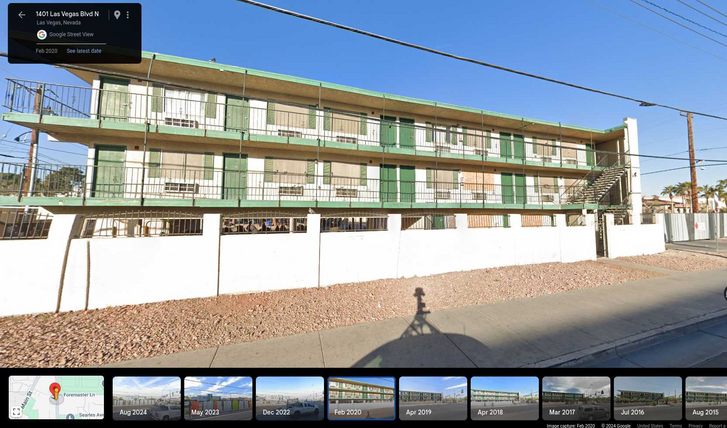
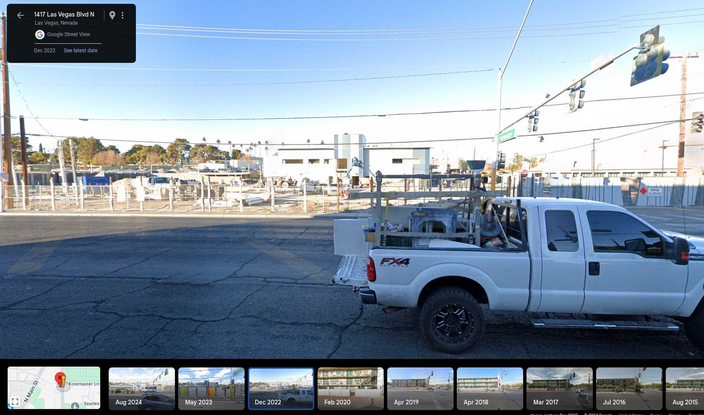
Despite the fact that this building was demolished sometime in 2022 at the latest, as of September 30, 24 of the voters that were registered were registered after January 1, 2023, the most recent of which has a registration date of September 26, 2024. With that said, 109 of the voters registered at this address are inactive voters, which is not surprising considering that the address no longer exists.
Along with 1401 Las Vegas Blvd, 9 of the other nonexistent addresses in voter precinct 4510 were located on either Foremaster Ln and Las Vegas Blvd N near the site of The Courtyard. When I visited the area, I had a conversation with two security officers who revealed that the only real addresses on Foremaster Ln between N Main St and Las Vegas Blvd N are The Courtyard (314 Foremaster Ln) and the CARE Complex (200 Foremaster Ln). Despite this, there were voters registered at 300, 301, 319, 400, 410, and 413 Foremaster Ln, which while they do not exist are in the range of addresses on that stretch of street. There were also voters registered at 1301, 1391, 1415, and 1417, all of which are located where the parking lot of 314 Foremaster Ln now is. All of these voters are registered in voter precinct 4510.
480 Bonanza Way
480 Bonanza Way and 480 Bonanza Way # 115, where a total of 22 voters are registered, are the two addresses previously mentioned that have a large discrepancy between the way they were inputted in the registration list and the way they were formatted by the CASS validator. Between these If you input "480 Bonanza Way" into the CASS address validator, it gets converted to "480 W Bonanza Rd". You get the same result if you input the address into the USPS ZIP Code Lookup by Address tool. This discrepancy is why I initially targeted this address, along with the addresses that had no USPS match and the non-postal addresses.
Bonanza Way is a short residential street that is located just to the north of E Bonanza Rd, between N Veterans Memorial Dr to the west and Las Vegas Blvd N to the east. It is also located within precinct 4510. Towards the western end of Bonanza Way is a cul-de-sac.
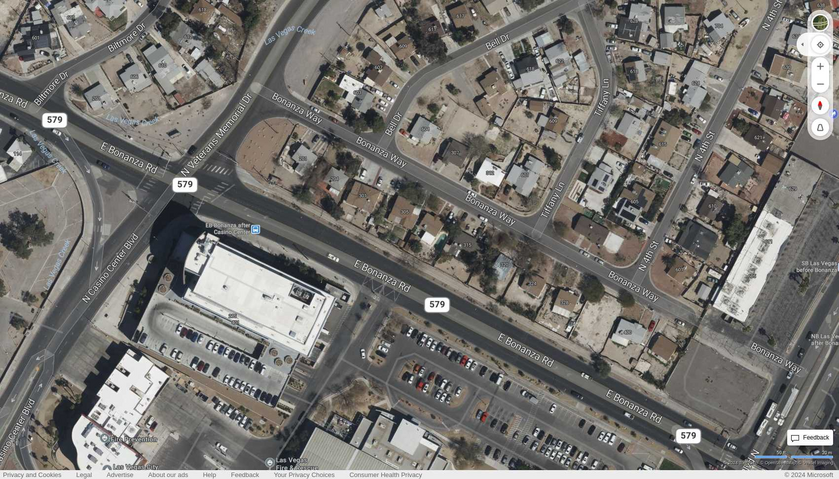
The highest numbered address on Bonanza Way, located towards the western end of the street, is 400 Bonanza Way, although there is one house after that which appears to be 404 Bonanza Way. Right after that is a fence that separates the residential cul-de-sac with what used to be a strip mall, judging from the satellite photo above. As of the time of writing, though, that area has been demolished, and is only an empty lot. This empty lot can be seen in the images below.
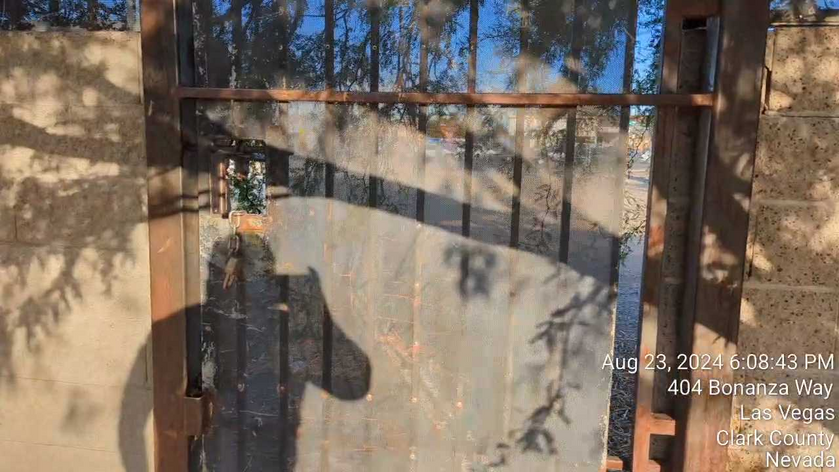
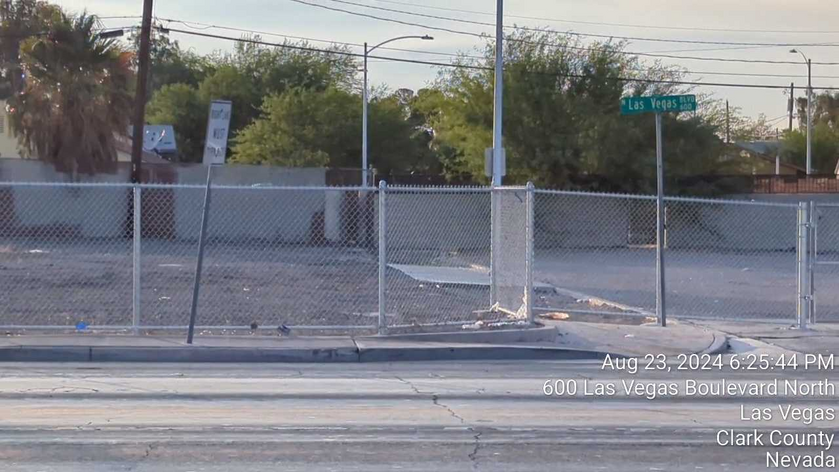
It is possible that addresses on that little stretch of the strip mall on the other side of the cul-de-sac could have had Bonanza Way addresses in the past, but this clearly is no longer the case. Whether or not 480 Bonanza Way could have existed in the past, it certainly does not exist now. This is probably why address validation formats the address as 480 W Bonanza Rd. This fact causes me to believe that it is also reasonable to assume that all mail that is sent to 480 Bonanza Way is sent to 480 W Bonanza Rd, which is located less than a mile to the west in Assembly District 6 and just so happens to be the address of the Las Vegas Rescue Mission.
Bonus Address: 100 N Main St
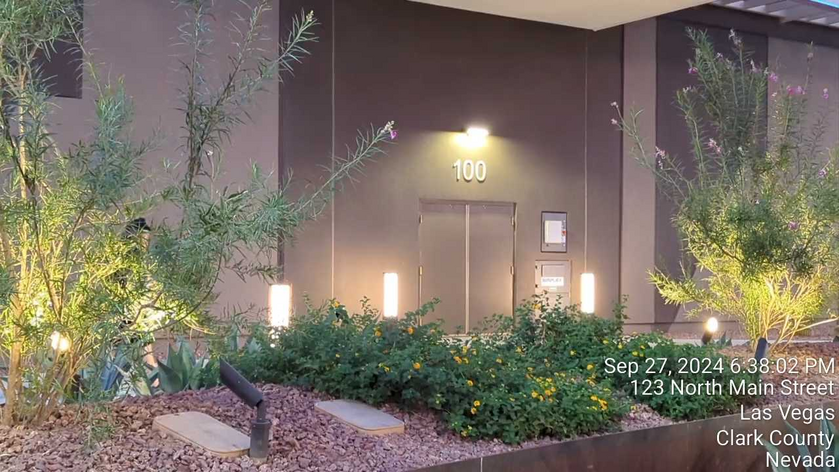
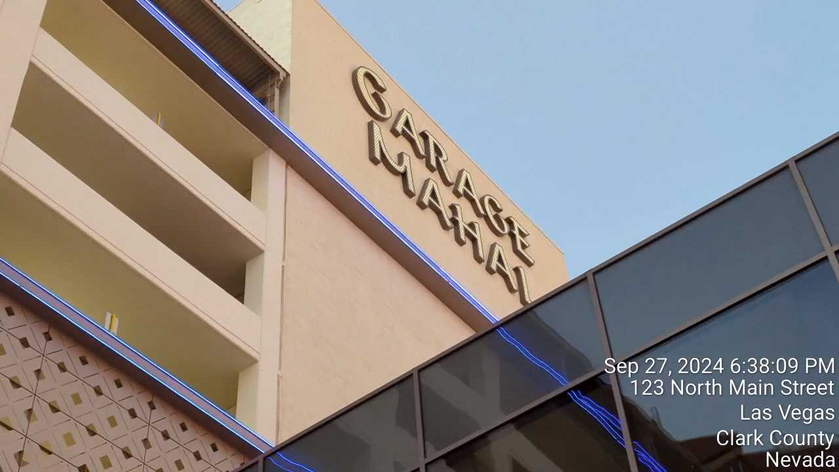
Unlike the other addresses mentioned here, 100 N Main St does exist. It is the site of the Garage Mahal, a parking garage that is across from Circa Hotel and Casino immediately to the north of the Plaza Hotel. As of September 30, 2024, one voter was registered there. Since it is hard to conceive of a person living inside of a parking garage, and this was flagged as a non-postal address, it is my belief that the voter here is improperly registered.
What All of This Means
When people raise concerns about voter fraud in the United States, the mainstream media's common response is to say something like "voter fraud is rare" or that states have "complex systems to find and eliminate fraud." While it does appear as though the county and/or state have made some efforts to correct voter registration errors, the fact remains that there were 332 voters registered at 67 nonexistent addresses as of September 30, plus one voter registered at a parking structure. The presence of voters registered at nonexistent addresses does not necessarily imply fraud. Voters may have have input a wrong street number or a ZIP code. Election officials can also make mistakes when entering an addresses from paper registrations. However, the fact that so many voters were registered at so many nonexistent addresses so close to the election is strong evidence that both Nevada and Clark County are not doing anywhere near enough to keep and maintain accurate records. I am willing to believe that many of these nonexistent addresses are the result of such errors, although I personally find it hard to believe that registering voters at 480 Bonanza Way or the 24 voters that registered at 1401 Las Vegas Blvd N was not intentional.
Even if all of these voters were registered at nonexistent addresses due to clerical errors and nothing more, the fact that the county and state have been so ineffective at even a simple matter like address validation means makes it reasonable to wonder if they are able to properly manage other matters related to elections. If election officials cannot even prevent voters from registering at an address that was demolished two years ago, or efficiently remove voters that are registered at nonexistent addresses, it is reasonable to question their ability to maintain a fair and secure election. To be fair, half of the voters registered at the addresses I visited were listed as inactive, but the process described in NRS 293.530 will not remove these voters unless they fail to vote before the second general election after being labeled inactive, meaning that many of these voters will not be removed until after the General Election in 2026 at the latest. In the meantime, should these voters choose to vote, they will automatically be labeled as active voters again. And even though historically speaking these voters have a very low rate of participation in elections, the fact remains that any and all of these voters, whether they are active or inactive, can vote in this election.
While all allegations of voter or voter registration fraud should be backed with clear, hard evidence, it is not the citizen's responsibility to prove to electoral officials that an election was not secure. Rather, it is electoral officials' responsibility to prove that elections are secure. It is not unreasonable to expect the state of Nevada and Clark County to maintain accurate records, especially since sending notices to nonexistent addresses wastes taxpayer money. Furthermore, having voters registered at nonexistent addresses forces candidates to waste money sending campaign materials to these addresses and waste time sending door knockers to find voters at addresses that do not exist. This is particularly egrigious due to the fact that many candidates pay a fair amount of money for voter lists.
How We Solve This Problem
While the process that NRS 293.530 describes for removing inactive voters is long and has proven insufficient in solving the problem of voters registered at nonexistent addresses, this same law also states that county election officials "may use any reliable and reasonable means available to correct the portions of the statewide voter registration list which are relevant to the county clerks and to determine whether a registered voter’s current residence is other than that indicated on the voter’s application to register to vote." County election officials may also "make investigations of registration in the county by census, by house-to-house canvass or by any other method" with the approval with the county board of commissioners.
My research indicated that when excluding input errors, 81.55% of the addresses that had no USPS match when run through a CASS verification platform were nonexistent addresses. Most of the "input errors" mentioned were cases when a unit number was listed as something like "UNIT APT 133" in the registration list (yes, it really is that bad), while one was due to a wrong ZIP code. Nevertheless, this demonstrates CASS processing is indeed a highly reliable means of not only identifying nonexistent addresses, but also fixing input errors (such as using two unit descriptors like "UNIT APT" in a secondary address).
The Clark County Election Department must immediately implement CASS validation for the addresses of all new registered voters. If these voters are registered to addesses that do not have a match in USPS's system, they should only be permitted to vote with provisional ballots unless they have presented evidence that their address does in fact exist. The Clark County Election board must also use CASS validation to examine the addresses of all voters registered in Clark County. In the case of minor discrepancies (like incorrect the ZIP codes or poorly formatted secondary addresses mentioned above), they can correct these errors, and also compile a list of voters that are registered at nonexistent addresses. After compiling this list, they must then request permission from the Clark County Commission board to investigate these voters' registrations to see if these voters' registrations are valid or not. In cases where they are not valid, these voters must be removed from the voter registration list.
What We Should Do
For Nevada residents, it is important to learn all that we can about how voter registration works in Nevada. Although I am not a lawyer, and this is not legal advice, I recommend reading the text of NRS 293.486, NRS 293.541, and NRS 293.530. I believe the text of these laws will be helpful in understanding how voter registration works in Nevada.
I also recommend researching terms like Coding Accuracy Support System (CASS), Delivery Point Validation (DPV), and Residence Delivery Indicator (RDI), all of which can help determine an address's existence (or lack thereof), as well as whether an address is commercial or residential. It is not enough to just repeat platitudes like, "Why can't the voter registrar use software to verify addresses?" It is important to know what these terms are and how these systems work in order to hold our lawmakers accountable so that we can craft laws that prevent voter registration irregularities.
Finally, I urge my readers to not assume that because you do not live in Nevada or a "blue state" that this kind of thing does not happen where you live. This kind of mismanagement is possible in any county or state in the Union. Our Republic needs to be maintained by people who are vigilant, knowledgeable, and hard-working. Freedom isn't free, and neither will elections unless we make great efforts to keep them fair and honest.